
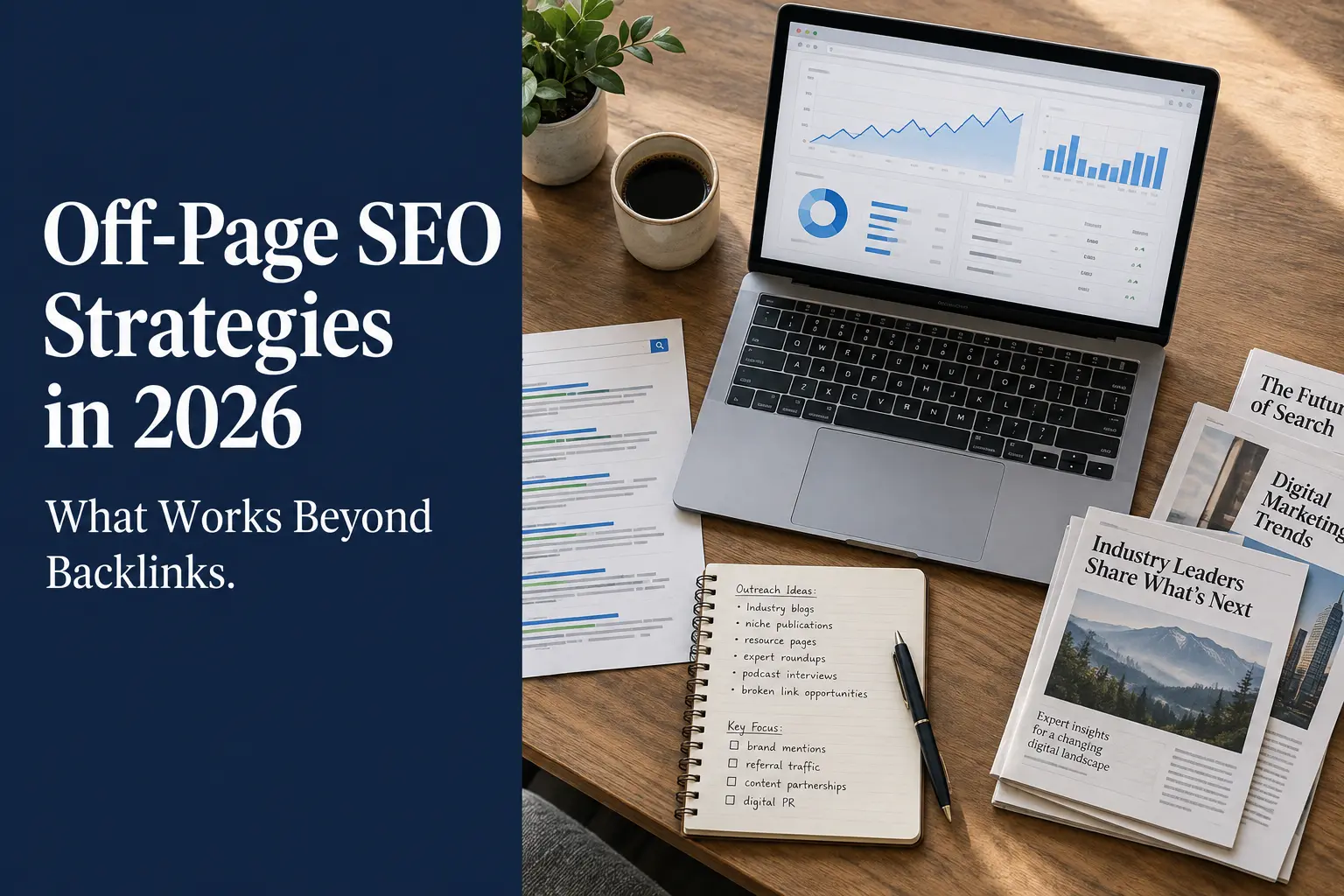
You publish a helpful article, optimize its title, and wait for visitors. But search visibility does not depend only on what happens on your website. What other sites say about your business matters too.
That is where off-page SEO strategies comes in. It covers activities beyond your website that help people discover, discuss, recommend, and sometimes link to your brand. For an ecommerce store, that could mean a product mention in a niche publication, a useful answer in a community, or a listing in a relevant industry directory.
The goal is not to place your URL on as many websites as possible. It is to earn attention in places your potential customers already trust. That distinction matters even more when you want your brand to be discoverable through both traditional search and AI-powered answers.
What is off-page SEO?
Off-page SEO is the work you do outside your own site to strengthen its visibility and reputation. Quality backlinks are one part of it, but they are not the whole strategy. Brand mentions, relevant partnerships, reviews, local listings, and conversations in trusted communities can also introduce new people to your business.
Think of it this way: your website explains who you are. Off-page activity gives other people a reason to talk about you.
A useful mention should make sense even if it sends no SEO benefit. If a link brings the right readers, answers a real question, or helps customers compare options, it has business value beyond rankings.
Are backlinks still important for SEO?
Yes, but quality matters far more than a large link count. One relevant mention from a respected publication in your niche can be more useful than dozens of links from unrelated submission sites.
Start with something worth referencing. That might be an original survey, a practical buying guide, a clear comparison, or expert input on a question your customers often ask. Then identify publications, creators, and businesses whose audiences would genuinely find it helpful.
Avoid treating outreach like a numbers game. A short, specific message explaining why your resource fits someone’s existing article is more convincing than a generic request to “exchange backlinks.” The strongest links usually come from a good match between the resource, the publisher, and the reader.
Do social bookmarking and classified submissions help SEO?
Social bookmarking and classified sites are often included on old off-page SEO activities checklists. Posting the same link across dozens of them may create a report full of completed tasks, but that does not mean it creates meaningful visibility.
Use a platform only if its audience is relevant and your contribution belongs there. A classified listing can make sense when you are genuinely advertising something to local buyers. A bookmarking community can be useful if people actively use it to discover resources like yours. Neither should be treated as a shortcut to rankings.
The same test applies to PDF submission. A useful guide, checklist, or research report in PDF format can help an audience. Uploading a thin document to many sites just to include a link is a different activity, and usually a poor use of time.
Does forum marketing work for SEO?
It can work for discovery and trust when you participate like a person, not a link-building bot. Find communities where your customers ask questions, read the rules, and answer with enough detail to help even if nobody clicks through.
For example, a skincare brand might explain how to read an ingredient list or how to compare product formats. If a relevant guide on its website adds useful detail, a link may fit naturally. If the answer is only a teaser followed by a URL, it probably will not earn trust.
Forum marketing for SEO is best viewed as a way to learn your audience’s language and build a credible presence. The questions people ask there can also inspire better product pages and blog posts.
How do brand mentions and digital PR help E-commerce stores?
Digital PR means giving journalists, creators, and publishers a useful reason to feature your business. You do not need a huge announcement. Original data, a thoughtful expert comment, an unusual customer insight, or a genuinely useful resource can all become a story.
For off-page SEO for ecommerce, product relevance matters. A mention in a publication your buyers read is usually a better fit than a link on a site with no connection to your category. Partnerships with complementary businesses can work for the same reason: both audiences get something useful.
Brand mentions also help people recognize your name when they encounter it again. Some mentions include links and some do not. Do not assume every unlinked mention has a measurable ranking effect; assess it for relevance, referral traffic, and the credibility it brings.
Can off-page SEO help with AI search visibility?
Potentially, but there is no reliable “submit here to rank in AI answers” formula. AI search experiences differ, and a brand mention does not guarantee that an assistant will cite or recommend your website.
The practical approach is to make your business easy to understand and easy to verify. Publish clear, accurate answers on your own site. Keep important business and product details consistent where your brand appears elsewhere. Seek relevant coverage from credible sources rather than trying to manufacture mentions at scale.
If a publisher describes your product incorrectly, ask for a correction. If customers repeatedly ask the same question in communities, answer it properly on your site too. This combination of clear first-party information and independent, relevant references is more useful than chasing an AI ranking trick.
What about local citations?
If you serve customers from a physical location, relevant local citations can help people find accurate details such as your business name, address, and hours. Keep those details consistent and update listings when something changes.
An online-only store should be more selective. It does not need to appear in every local directory. Industry-specific directories, supplier pages, and relevant partner listings are more sensible places to focus.
How should you measure off-page SEO?
Track outcomes, not submission counts. Look at which mentions bring visitors, whether those visitors engage with your site, and whether relevant publications continue to reference your work. Search visibility and sales may take time to change, so note when activities happened and review trends over several months.
A simple monthly routine works: publish one resource worth sharing, contact a small number of well-matched publishers, contribute to relevant conversations, and check that existing brand information is accurate. That is less flashy than “100 backlinks in a week,” but it gives you a clearer reason to expect lasting results.
The best off-page SEO strategy is not about being everywhere. It is about being useful and credible in the places that matter to your customers. Start there, and let links be an outcome of good work, not the only goal.
Shopify’s SEO guidance also emphasizes relevant, quality backlinks over large numbers of low-quality links, and notes that social activity can support discovery without being a direct ranking factor.