
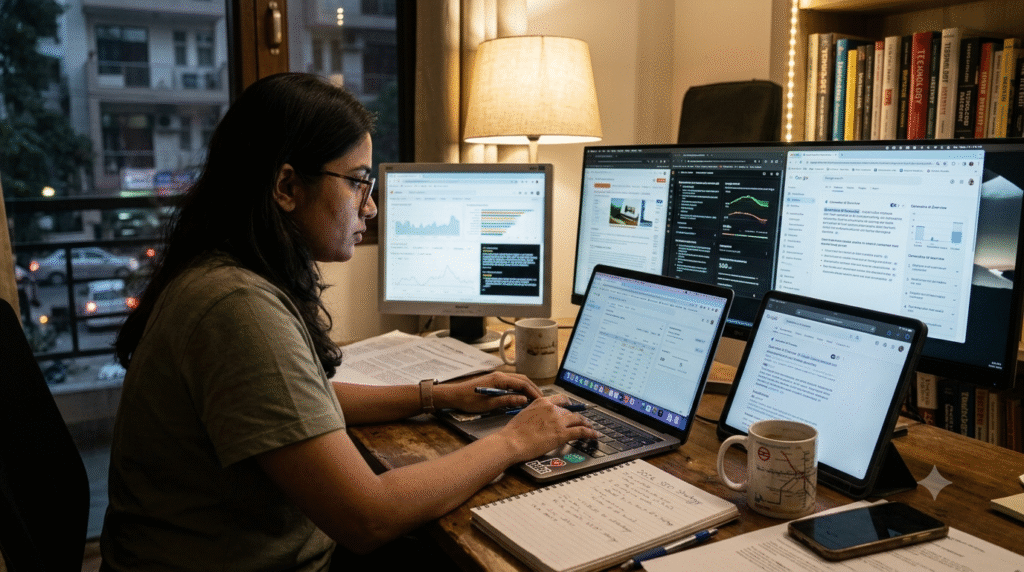
If you’ve been doing SEO for more than a year, you already know the feeling. Just when you finally understand the rules, someone moves the goalposts.
Well, they’ve moved again. And this time it’s bigger than any algorithm update we’ve seen before.
Search isn’t just Google anymore. It’s ChatGPT. It’s Gemini. It’s Perplexity. It’s the AI Overview sitting at the top of a results page, quietly answering the question before anyone even scrolls down to your carefully optimized blog post. So the real question in 2026 isn’t “how do I rank on page one” – it’s “how do I get found and cited no matter where someone is searching.”
Let’s break down what’s actually working right now, without the fluff.
Search Has Split Into Two Worlds
There’s traditional SEO, which is still very real. People still Google things. Google still has billions of searches a day, and honestly, it processes far more queries than AI chatbots do combined. So don’t let anyone tell you SEO is dead – it isn’t.
But there’s also a second world now: Generative Engine Optimization (GEO) and Answer Engine Optimization (AEO). This is the practice of getting your content pulled into AI-generated answers – the summaries you s# SEO Trends 2026: How to Rank on Google AND Get Cited by AI (The Complete Guide)
1. Experience Beats “Expertise” Now
Google’s E-E-A-T framework – Experience, Expertise, Authoritativeness, Trustworthiness- isn’t new. But the “Experience” part has quietly become the most important letter in that acronym.
Search engines and AI models are getting much better at spotting generic, faceless content that reads like it was written to check a keyword box. What’s winning instead is content written by someone who’s actually done the thing. A skincare review from someone who used the product for three months. A software comparison from someone who actually built something with each tool.
If you’re writing “10 Best Project Management Tools in 2026,” that title alone is a red flag to both readers and algorithms. Compare it to “I Used 6 Project Management Tools for a Year – Here’s What Actually Stuck.” One sounds like content marketing. The other sounds like a person.
Actionable tip: Add real specifics – screenshots, timelines, numbers, mistakes you made. This is what both human readers and AI models increasingly treat as a trust signal.
2. Structure Your Content So AI Can Actually Use It
AI models don’t “read” your page the way a human scrolls through it. They parse structure. That means clear headers, FAQ sections, and schema markup aren’t just nice-to-haves anymore – they’re how you get pulled into an AI Overview or a ChatGPT answer in the first place.
A few things that consistently help:
- FAQ sections answering the exact long-tail questions people ask (voice search and AI chat both favor natural, conversational phrasing)
- Schema markup so search engines and AI crawlers understand what your content actually is
- Short, direct answers near the top of a section, followed by the deeper explanation – AI models tend to lift the first clear, self-contained sentence
Think of it like writing for two audiences at once: a human who wants the full story, and a machine that wants a clean, quotable sentence it can hand off as an answer.
3. Brand Signals Are the New Backlinks
This is the trend that’s catching a lot of SEOs off guard. AI systems don’t just look at your website – they aggregate everything the internet says about you. Reviews, forum mentions, Reddit threads, podcast interviews, PR coverage, social chatter. All of it gets folded into whether an AI system trusts you enough to recommend you.
That means brand building is no longer a “nice extra” sitting next to your SEO strategy. It is your SEO strategy, in large part. A small brand with strong, authentic word-of-mouth across Reddit, review sites, and industry forums can genuinely outrank a bigger competitor with a weaker reputation.
Actionable tip: Get mentioned in places AI models actually pull from – Reddit threads, niche forums, industry roundups, comparison sites, and podcasts. A single glowing thread on Reddit can do more for your AI visibility than a dozen average backlinks.
4. Zero-Click Searches Are the New Normal – Plan For It
A huge share of searches now end without anyone clicking a single link, because the answer already appeared in an AI Overview or featured snippet. That’s frustrating if you’re chasing raw traffic numbers.
But here’s the flip side: the people who do click through are more qualified than ever. They’ve already gotten the surface-level answer from the AI summary – anyone still clicking wants depth, proof, or a next step. That’s a warmer visitor than the old-school “quick question” searcher ever was.
Actionable tip: Stop optimizing purely for pageviews. Optimize your zero-click content (the part that might get quoted in an AI answer) to build brand recognition, and save your best, most in-depth material for what happens after the click — comparisons, calculators, case studies, things AI can’t easily summarize away.
5. Local and “Near Me” Searches Are Getting More Personal
For local businesses, 2026 SEO isn’t about ranking for a whole city anymore – it’s about owning a specific neighborhood or niche. Voice search and AI assistants are handling more “best coffee shop near me” or “plumber open now” type queries, and they favor businesses with complete, consistent listings and strong review signals.
Actionable tip: Fully optimize your Google Business Profile, keep hours and categories accurate, and actively collect reviews. This single step still moves the needle more than people expect.
Final Words
SEO in 2026 isn’t dying – it’s splitting into two connected disciplines: ranking on traditional search, and getting cited by AI. The good news is they reward a lot of the same things: real experience, clear structure, genuine brand trust, and content that actually helps someone.
Chase both, and you’re not just optimizing for an algorithm. You’re building something that holds up no matter how search keeps changing – because at the end of the day, that’s what both Google and AI are ultimately trying to reward: content that real people find genuinely useful.